1. Why Does Heel Elevation Matter In A Squat?
When performing a barbell back squat, your knees must travel forward past your midfoot to allow your hips to descend between your heels. This forward knee motion requires closed-chain ankle dorsiflexion.
If your calves are tight, your Achilles tendon is stiff, or your talocrural joint has limited boney clearance, your knee reaches its forward limit prematurely. When that happens, your body compensates in one of two catastrophic ways:
- Your heels lift off the ground: Destroying your balance and loading dangerous shear force onto your patellar tendons.
- Your hips shoot backward and your torso collapses forward: Turning your squat into an unintentional "good-morning," overloading your lower lumbar spine.
By artificially elevating your heel with a solid, non-compressible wedge, you place your foot in an artificial plantarflexed angle. This mechanically reduces the degree of dorsiflexion required to hit a full, rock-bottom squat by up to 15–20%.
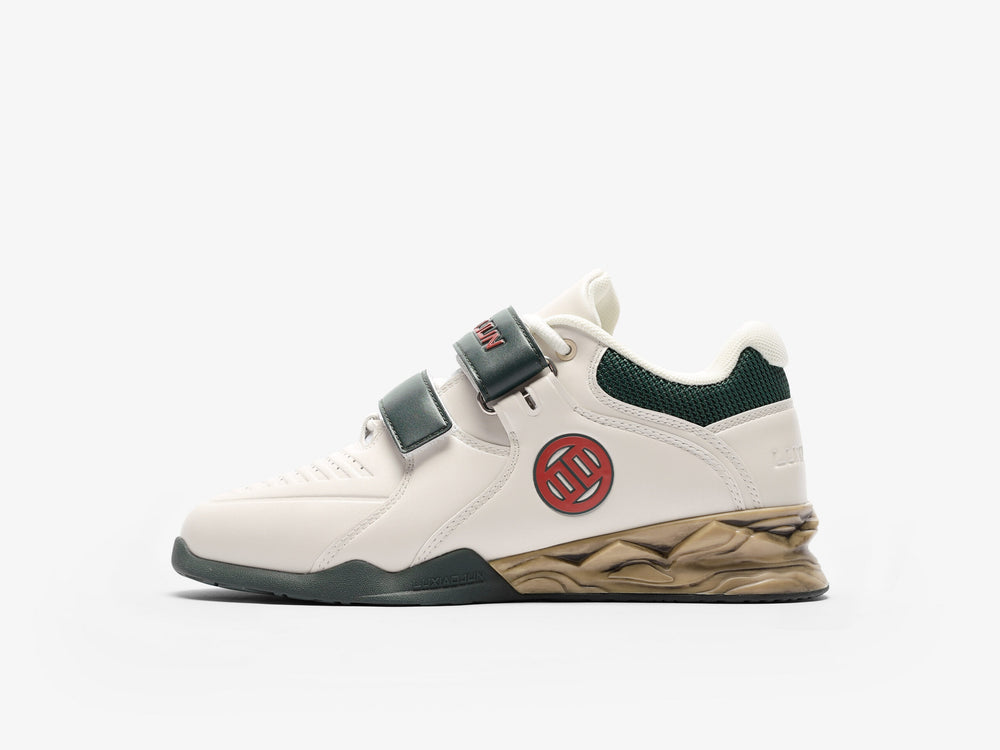
The 25mm solid TPU heel wedge on the LUXIAOJUN PowerPro provides immediate postural relief for lifters with long femurs.
2. The Physics of 20mm vs 25mm: Is 5mm Really Noticeable?
On paper, 5 millimeters sounds like a microscopic difference. In the physics of human lever arms, 5mm at the heel changes everything at the shoulder and hip joints.
Because your body functions as a kinetic chain, a 5mm increase in heel elevation shifts your knee joint roughly 1 to 1.5 inches further forward at the bottom of a parallel squat. This allows your pelvis to sit more vertically under the barbell, instantly shifting your torso angle upright by 5 to 8 degrees.
3. Long Femurs: The Ultimate Test For Heel Height
If you have long thigh bones (femurs) relative to your torso, squatting deep without leaning excessively forward is a geometric impossibility without heel elevation.
For long-femured lifters, a standard 20mm heel (like the Nike Romaleos 4 or Adidas Adipower) is often simply not enough. The 25mm heel drop found on the LUXIAOJUN PowerPro was specifically engineered for Chinese and international Olympic lifters who need to receive heavy snatches and cleans with a completely vertical spine.
Quick Reference: Matching Heel Drop to Your Squat Style
| Heel Drop | Ideal Squat Style | Best Body Mechanics | Benchmark Model |
|---|---|---|---|
| 25mm (1.0") | Olympic Lifts, High-Bar, Front Squat | Long femurs, stiff ankles | LUXIAOJUN PowerPro |
| 20mm - 22mm | Standard High-Bar & Hybrid Squat | Average proportions, standard mobility | Nike Romaleos 4 / Reebok Legacy 3 |
| 15mm (0.6") | Low-Bar Powerlifting | Short femurs, wide stance, hip-dominant | Inov-8 Fastlift |
Frequently Asked Questions
Does a 25mm heel hurt your knees?
No. Healthy knees are designed to track forward over the toes. By keeping your torso upright, a 25mm heel relieves excessive torque from your lumbar spine and distributes force evenly across the leg musculature.
Can you deadlift in 25mm squat shoes?
We strongly advise against it. The elevated heel increases the vertical distance you have to pull the bar and pushes your center of mass forward. Use flat shoes or barefoot slippers for deadlifts.