1. The Golden Rule: Why You Must Never Squat in Running Shoes
Before comparing squat shoes against flat shoes, let us make one rule crystal clear: running shoes, cushioned cross-trainers, and Air Maxes have zero business inside a squat rack.
Running sneakers are built with squishy ethylene-vinyl acetate (EVA) foam engineered to absorb shock. When you load 250, 350, or 450 lbs across your upper back, that soft cushion squashes unpredictably under your feet. It is identical to attempting to squat while standing on two wobbly water balloons. Energy leaks into the midsole, your ankles collapse inward (pronation), and your knees are exposed to extreme lateral shear stress.
Both elevated weightlifting shoes and flat skate shoes (Vans / Chucks) solve this problem by providing a non-compressible platform. But how do you decide between the two?
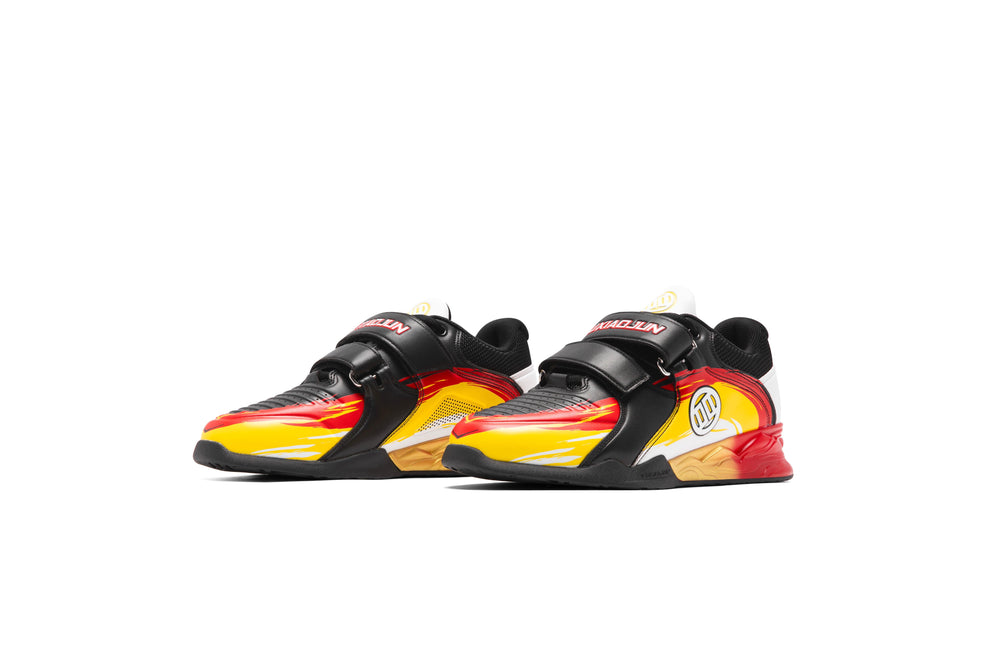
Unlike squishy running shoes, the solid 95 Shore A TPU wedge of the LUXIAOJUN PowerPro provides instantaneous force transfer directly into the floor.
2. The Case for Flat Shoes (Vans, Chuck Taylors & Barefoot)
Walk into any hardcore powerlifting gym, and you will see dozens of athletes squatting in classic \$65 Vans Old Skools or high-top Converse Chuck Taylors. Why?
- Low-Bar Squat Mechanics: Powerlifters generally perform low-bar back squats with a wide stance. In this style, the movement is hip-dominant rather than knee-dominant. Because the knees don't need to travel far forward, ankle dorsiflexion demands are minimal, making a flat zero-drop shoe perfectly adequate.
- Universal Utility (Squat + Deadlift in One): You cannot deadlift in elevated squat shoes without disadvantage. Flat shoes allow you to perform your entire lower-body workout in one pair of shoes.
- Affordability: A pair of canvas Vans costs a third of a dedicated lifting shoe.
3. The Case for Elevated Squat Shoes (The 25mm TPU Advantage)
Olympic weightlifters and bodybuilders almost universally choose dedicated lifting shoes with an elevated solid heel (ranging from 20mm up to 25mm):
- Effortless Rock-Bottom Depth: By elevating the heel, your shin can tilt forward significantly further before running out of ankle room. You hit parallel and deep "ass-to-grass" depth effortlessly.
- 100% Upright Torso: Because your hips can drop straight down between your ankles rather than pushing way behind you, your spine stays completely vertical. This eliminates compressive shear forces on the lumbar discs.
- Quad Hypertrophy: Greater forward knee flexion places direct, maximal tension across the quadriceps (rectus femoris and vastus medialis/lateralis), making elevated shoes the gold standard for building massive legs.
Want the Best of Both Worlds?
The LUXIAOJUN PowerPro combines a 25mm TPU wedge with an anatomical wide toe box.
4. Can You Just Put 2.5 lb Weight Plates Under Your Heels?
Many gym-goers attempt to mimic squat shoes by placing two 2.5 lb or 5 lb iron plates under their heels while wearing sneakers or socks.
While this confirms that heel elevation helps your squat mechanics, it is inherently dangerous under heavy loads:
- Your heel can easily slip or slide off the curved edge of an iron plate during a max effort repetition.
- Plates only elevate the back 30% of your foot, creating a sharp pressure bend across your plantar fascia and arch.
- Dedicated shoes like the LUXIAOJUN PowerPro support the entire kinetic chain: from the contoured spoon insole and arch support all the way down to the diamond rubber platform grip.
5. The Final Verdict: What Should You Buy?
Here is our simple coaching recommendation:
• If you are purely deadlifting or doing wide-stance low-bar squats, stick to your flat Vans or Converse.
• If you want to master deep back squats, front squats, Olympic lifts, and protect your lower back from forward collapse, invest in a premier pair of elevated shoes like the LUXIAOJUN PowerPro. The difference in posture, quad activation, and confidence under the bar is night and day.